
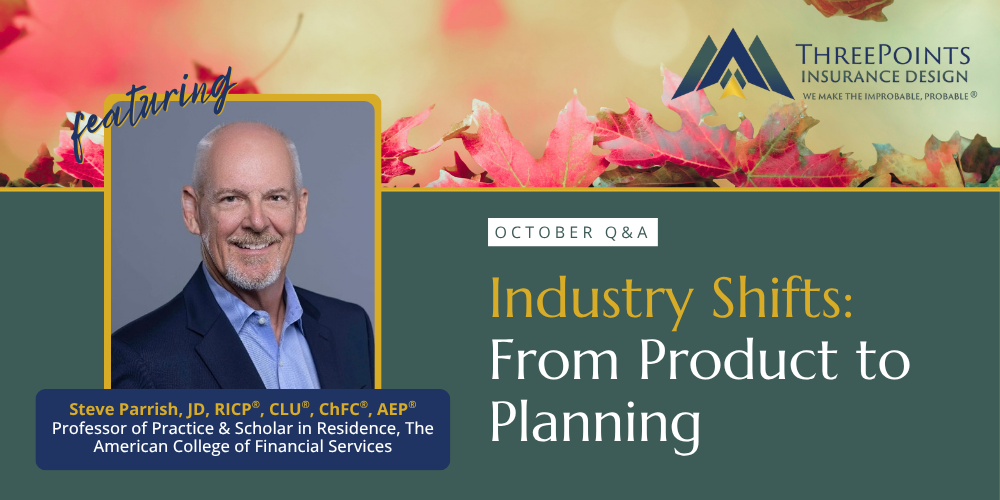
This month, Steve Parrish, JD, RICP®, CLU®, ChFC®, AEP®, Professor of Practice and a Scholar in Residence at The American College of Financial Services, joins us to share his perspective on the evolving role of life insurance within comprehensive financial and estate planning.
 Getting It Right The First Time
Three Points: You’ve spent decades in financial services and have experienced the industry from several different perspectives. What originally attracted you to this business, and what has kept you passionate about it throughout your career?
Steve: When I was an attorney, I was frustrated by the fact that the work I did was “after the fact”. The financial services industry presented an opportunity to work with clients getting it right the first time around instead of hiring an attorney to clean up things after they had gone wrong. I wanted to be a planner, not a fixer.
It’s Not MagicThree Points: October is Financial Planning Month. When you think about a truly comprehensive financial plan today, where should life insurance fit into that conversation?
Steve: Most of us want to live a happy retirement, and then leave a legacy. Life insurance is not something magic – it is simply an efficient tool to help fulfill our financial goals. Too often it is ignored because it deals with death. But that’s the wrong way to look at it. Life insurance addresses risk – yes, the risk of death, included – in a way no other financial asset can. It provides tax free dollars when needed most, and by doing so, it also provides peace of mind.
The Evolution of Life InsuranceThree Points: Life insurance has traditionally been discussed primarily as protection against premature death, but today it can also play a role in areas such as retirement income, long-term care, business planning, and wealth transfer. Has the industry done a good enough job evolving the way we talk about life insurance with clients?
Steve: I’ve had 50 years to watch the life insurance industry evolve. It used to be not much more than a way to provide liquidity when an unexpected death occurred. Now, the life insurance product has legitimately evolved into a financial chassis to address a number of risks – dying too soon, living too long, and the “living death” of a long-term care event. The clear challenge is that this makes the life insurance product incredibly complex to explain. We need to do a better job of taking these complicated, even arcane, concepts and explaining them to clients in a way that reveals the need, demonstrates the solution, and addresses unasked questions.
The Investment & Insurance DivideThree Points: There can sometimes be a divide in financial services between the investment world and the insurance world, almost as though clients need to choose one philosophy or the other. Why do you think that divide still exists, and what does a more integrated approach to financial planning look like?
Steve: Old tropes don’t die easily. Whether deserved or not, life insurance had a bad rap in the past, and some advisors are, frankly, playing old tapes. To me it is a violation of an advisor’s duty to his/her clients to fail to discuss life insurance. It fits in so many financial plans that ignoring it or disparaging it is just short of gaslighting the client.
Insurer SolvencyThree Points: October also includes Estate Planning Awareness Week. When you look at estate planning today, what is one issue or planning opportunity you believe advisors and their clients may not be paying enough attention to?
Steve: A few years ago, I would not have raised this issue. But a legitimate current concern is the solvency of some insurers. The hiding of solvency through offshore reinsurance, private debt and affiliated contracts is causing the investment community to ask about the long-term viability of some carriers. It is incumbent on the advisor to separate the wheat from the chaff – the quality companies for the wannabe hedge fund owned new players. We need to expose the dubious companies and celebrate the quality carriers.
Not All Illustrations Are Created EqualThree Points: Life insurance illustrations can be incredibly useful, but they are ultimately based on a set of assumptions that may play out very differently over several decades. How should financial professionals use illustrations effectively without allowing the illustration itself to become the recommendation?
Steve: Not all illustrations are created equal. While they can be used to demonstrate how a life insurance policy might work, they can also be a sham that glorifies the good and hides the bad. My concern is primarily focused on Indexed Universal Life illustrations. They can obfuscate and confuse, and may be more trouble than they’re worth. With other life insurance products, I’m not as concerned, but I have to say the advisor should be wary of using illustrations as their primary tool for presenting life insurance to prospective customers.
Stress Testing is KeyThree Points: Permanent life insurance policies are often expected to remain in force for decades, during which interest rates, policy charges, market performance, and client circumstances can all change. How important is stress testing when designing a policy, and what should advisors be looking for beyond the original illustrated outcome?
Steve: Stress testing is key. First, reviewing the carrier – its financials and its ratings – is a job the advisor should perform for clients. Second, because of the internal mechanics of so many interest sensitive permanent life insurance policies, annual reviews are a necessity. Changes in mortality, interest rates, outside indices and the client’s own financial situation can affect the long term prospects for the product. Ongoing reviews help catch changes and offer ways to fix problems before they become unfixable.
Finding the Right SolutionThree Points: You’ve spent a significant part of your career educating financial professionals. In your experience, what separates an advisor who is truly skilled at advanced planning from someone who simply has a strong knowledge of financial products?
Steve: I’m gratified to see how the industry is shifting from product peddling to planning. It is fine to be passionate about the product one offers, but at the end of the day, we’re here to solve our client’s needs. Let me use a metaphor. If your client needs a pick-up, it shouldn’t matter that you can get them a sporty sedan at a great price. This means we need to understand their transportation needs, not be the all-knowing expert on four wheeled vehicles. If you can help them assess their needs, there are all kinds of resources to help you find the solution. Knowing your client is more important than just knowing your product. That said, knowing your client also means knowing what their options are. You owe it to them to understand what’s out there, what works and doesn’t work, and who can help you find the right solution.
What Great Collaboration Looks LikeThree Points: Complex planning cases often involve an advisor, insurance professional, CPA, attorney, and other specialists working together. What does great collaboration among those professionals look like, and where do you most often see that process break down?
Steve: Think of it this way. You can have an attorney, a CPA and a financial advisor. The math can be 2+2+2 equals 4 or it can be 2+2+2 equals 10. In other words, professionals work best when they collaborate because no one knows as much as all of us know. When professionals work in silos, not only do they not benefit from what the client’s other professionals know; they can also unwittingly harm the client. A failed beneficiary designation, a mixed tax opportunity, a missed deadline. All these can be avoided by getting the professionals to work with each other. And, in my opinion, this is one of the primary duties of the client. Ultimately, they are the ones who suffer if it doesn’t happen, and they are the ones who can make it happen the right way.
Fiduciary ResponsibilityThree Points: If you could change one thing about the way the life insurance industry approaches case design, client education, or policy recommendations, what would you change?
Steve: I would require life insurance agents to have a direct, fiduciary responsibility to their clients. This will ultimately force advisors to work as teams, utilize effective services tools, and transition insurance sales into financial planning.
The Bonus RoundThree Points: When you have the opportunity to completely unplug from financial services, what do you most enjoy spending your time doing?
Steve: I’m not sure I ever unplug from financial services. It’s a calling for me! However, where do I do my best (and most enjoyable) thinking? In a kayak. Some days I wish I had gills, so I could spend all my time in or on the water!
 About Steve Parrish, JD, RICP®, CLU®, ChFC®, AEP®
Steve Parrish is Professor of Practice and a Scholar in Residence at The American College of Financial Services. He was also recently an Adjunct Professor of Estate Planning and Interim Director of the Compliance and Risk Management at the Drake University Law School.
With over 45 years’ experience as an attorney and financial planner, Parrish is an expert on retirement, estate, and business owner succession planning. He is a recognized industry authority, spokesperson and author serving as a contributor for publications such as Forbes.com, Kiplinger and Rethinking65. He is a contributing author to the 2024 e-textbook Retirement Plans and Retirement Planning. and co-author of the 10th Edition of National Underwriter’s Tools & Techniques of Life Insurance Planning (2026). He was the 2023 winner of the Kenneth Black Jr. Journal Author Award and has written for the Journal of Financial Service Professionals (where he also an Associate Editor), Journal of Financial Planning and Hastings Business Law Journal.
Parrish has served as an expert source for such prominent media outlets as The New York Times, Wall Street Journal, CNBC, National Public Radio, InvestmentNews, Money.com, USN&WR, and AARP The Magazine. He has also served as an expert witness. In addition, he is a sought-after speaker for bar associations, estate planning councils and financial service industry meetings.
Parrish was employed at The Principal Financial Group from February 1997 until June, 2015 when he began his academic career with The American College and Drake University Law School. Prior to that, he served as vice president, marketing services for Amerus Life Insurance Company. He began his career as an attorney and advanced sales director and subsequently became a financial planner in Atlanta. Steve received his B.A., Cum Laude, from Saint Olaf College and his Juris Doctor degree from the William Mitchell College of Law.