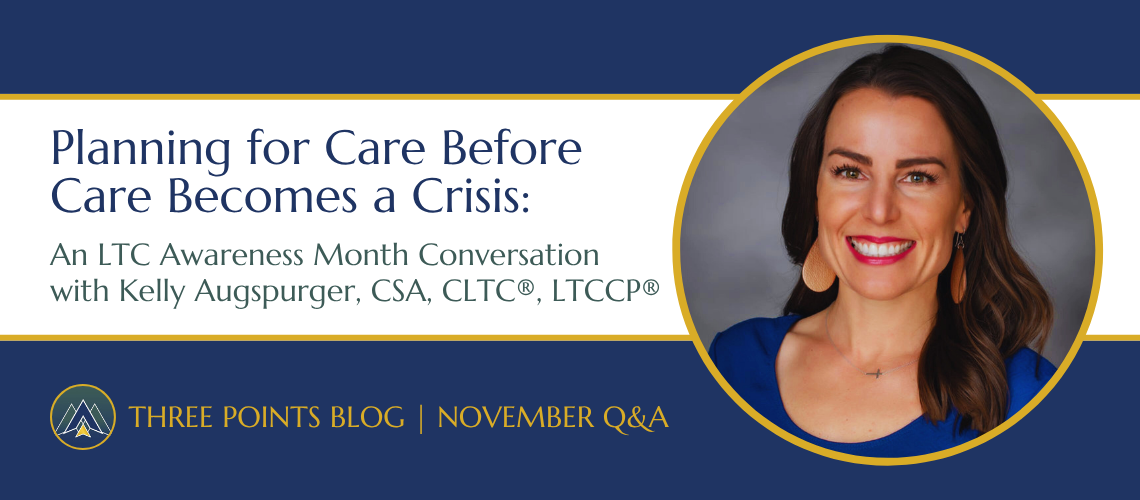
November marks Long-Term Care Awareness Month, a pivotal time to examine one of the most critical elements of a comprehensive financial plan. We sit down with Kelly Augspurger, CSA, CLTC®, LTCCP®, Long-Term Care Specialist and Co-Founder of Steadfast Insurance, to discuss the architecture of extended care planning. Drawing from her personal experience as a caregiver and her professional dedication to helping families lessen overall risk for their financial plans and legacies, Kelly provides answers for navigating the complexities of long-term care. In this Q&A, we explore the hidden toll on caregivers, the dilemma of self-insuring, and how intentional design can provide confidence for families long before a crisis occurs.

Three Points: Long-term care is one of those subjects that nearly everyone acknowledges is important, yet far too many families avoid discussing it until they’re faced with a crisis. From your experience, what keeps people from having these conversations earlier, and what would you say to someone who believes long-term care is something they’ll deal with if and when the time comes?
Kelly: It’s uncomfortable to think about a time when we might need help with everyday activities or experience cognitive impairment. We value our independence and it’s natural to want to believe, “That won’t happen to me.” But here’s what I tell people: The worst time to make decisions about care is when care is needed.
When care is needed unexpectedly, families are often forced to make difficult decisions about who will provide care, where it will happen, and how to pay for it – all while navigating the emotional stress of seeing someone they love struggle.
Proactive extended care planning isn’t about predicting the future or assuming the worst. It’s about being prepared for life’s uncertainties rather than making difficult decisions in the midst of a crisis.
We plan for care to protect our family, choices, and financial plan so we can live well today and in the future.
Three Points: When people think about the cost of long-term care, they typically focus on nursing homes, assisted living facilities, or home health aides. But the emotional, physical, and professional toll on family caregivers can be just as significant. What are some of the hidden consequences families often overlook, and how can proper planning help protect the people who may ultimately become caregivers?
Kelly: When people think about the cost of LTC, they usually think about the financial expense, but some of the greatest costs never appear on a bill.
Family caregivers often experience tremendous physical, emotional, and financial strain. Spouses may sacrifice their own health while caring for someone they love. Adult children may reduce their work hours, put careers on hold, or struggle to balance caregiving with raising their own families. Relationships can become strained, and caregivers can experience exhaustion, isolation, and burnout.
Just because your family loves you doesn’t mean they’re equipped to provide all the care you might need.
I encourage families to distinguish between providing care and managing care. Your loved ones can remain actively involved in your care without having to shoulder every responsibility themselves.
A thoughtful care plan identifies who will be involved, what responsibilities they’re willing and able to take on, where care might be provided, and how professional assistance will be funded.
The goal isn’t to eliminate family involvement. It’s to allow family members to be spouses, children, and loved ones first, not overwhelmed caregivers by default.
Three Points: You’ve worked with families navigating some incredibly difficult circumstances. Without sharing anything confidential, is there a particular situation or experience that illustrates what can happen when someone needs extended care without a plan in place? What lessons from that experience would you want every family to understand before finding themselves in a similar position?
Kelly: This topic is deeply personal to me because all four of my grandparents needed extended care and none of them had a comprehensive care strategy or LTC insurance.
My paternal grandpa suffered a stroke and eventually moved to a Veterans Affairs care facility about an hour away because providing care at home became too difficult and expensive. The distance made it harder for our family to visit and stay involved.
My maternal grandma also suffered a stroke. My grandpa cared for her at home for about five years, but the physical and emotional demands took a tremendous toll on his own health. Eventually, she needed nursing home care funded through Medicaid and our family’s options were limited.
Years later, that same grandpa remarried and needed extended care himself. His new wife was a nurse and cared for him at home for several years. Despite her medical training and experience, the demands of caregiving took a significant toll on her health and well-being. Even someone professionally trained to care for others can experience caregiver burnout.
I became an unexpected caregiver to my paternal grandma while I was in my early twenties. What started as helping with groceries, appointments, and household tasks gradually progressed to assisting with personal care. I loved my grandma, but I quickly realized that loving someone and being equipped to meet their increasing care needs are two very different things.
These experiences shaped both my personal perspective and my professional mission.
I saw firsthand that when a care strategy doesn’t exist, the responsibility doesn’t disappear. It falls on the people we love.
If my family had known then what I know now, we would have had conversations earlier, identified care preferences and responsibilities, and developed a strategy to fund care.
We couldn’t have prevented every challenge, but we could have reduced much of the stress, uncertainty, and burden on our family. That’s why I’m so passionate about helping other families plan before care becomes a crisis.
Three Points: One of the most common arguments against purchasing long-term care insurance is, “I’ve accumulated enough assets to pay for care myself.” For individuals and families with substantial wealth, when does self-insuring make sense, and when might it introduce unnecessary risk to their retirement income, estate planning objectives, or the financial security of a surviving spouse?
Kelly: Having sufficient assets to pay for care doesn’t mean using those assets is the most efficient strategy.
One of the principles I teach in CLTC (Certification for Long-Term Care) classes is that assets don’t directly pay for care, income and cash flow do. The important question isn’t simply, “Do I have enough money?” It’s “How will I generate the income needed to pay for care, potentially for years, without disrupting my other financial goals or placing unnecessary burdens on my family?”
Many high-net-worth individuals understand the value of leverage and transferring risk. After all, they insure their homes, cars, and health rather than assuming every potential expense themselves. Long-term care insurance can serve a similar purpose while providing access to benefits that are generally income tax-free.
For some affluent families, much of their wealth may be tied up in real estate, businesses, or investments. Self-funding a prolonged care event could mean liquidating assets at an unfavorable time, creating tax consequences, reducing retirement income, or diminishing assets intended for a surviving spouse or heirs.
One strategy I particularly like for clients with available assets is asset repositioning. Rather than committing to ongoing premiums from retirement income, they may be able to reposition a portion of their existing assets into a life or annuity-based LTC solution. For example, depending on the product, age, and health, repositioning $100,000 could potentially create $300,000 or more in immediate available LTC benefits. That’s meaningful leverage while helping preserve other assets for their intended purposes.
The value goes beyond the dollars. Many LTC insurance policies offer care coordination services, caregiver resources, and benefits that can help support care at home, including certain home modifications. Families who self-fund entirely would need to arrange and pay for those services themselves.
I also encourage clients to consider the impact of a prolonged care event on a surviving spouse. What happens if one spouse needs care for several years and the other still needs sufficient income and assets for the remainder of retirement?
LTC insurance isn’t necessarily about whether someone can afford care. It’s about whether transferring some of that risk creates a more predictable, tax-efficient, and effective strategy for protecting their family and financial plan.
For some high-net-worth families, self-funding may be their choice based on their personal preferences and risk tolerance. However, if they’re healthy enough to qualify for coverage, I believe it’s worth exploring the available options before deciding to self-fund entirely. It should be an intentional decision, not simply the default because they’ve accumulated substantial wealth.
Three Points: Today’s marketplace offers several approaches to funding long-term care, from traditional stand-alone coverage to hybrid life insurance and annuity-based solutions. Rather than focusing solely on product features, what factors should drive the decision between these strategies, and where do you see advisors making mistakes when recommending one approach over another?
Kelly: The good news is that we have a variety of LTC funding solutions available today, including traditional LTC insurance, life hybrids, annuity hybrids, life with LTC riders, and short-term care. I often tell advisors, “They’re all good, just different.”
There isn’t one solution that’s best for everyone.
The right solution depends on a person’s health, age, financial resources, existing income and assets, goals, preferences, risk tolerance, and what they want their coverage to accomplish. That’s why I believe education and health prescreening should happen before jumping into illustrations.
One mistake I see advisors make is designing coverage that attempts to insure 100% of potential care expenses, resulting in premiums that can create unnecessary sticker shock. They also run quotes without doing detailed health prescreening. I also see advisors limit their recommendations to the one or two carriers or products they’re most familiar with.
I use a co-funding strategy for families. LTC insurance provides a meaningful foundation of benefits, while other income sources such as Social Security, pensions, or investments help cover the difference.
Many of my clients choose coverage designed to address approximately 50–75% of their anticipated care expenses rather than trying to insure every dollar.
We already use a similar approach with other types of insurance through deductibles and copays.
My philosophy is simple: LTC insurance should be meaningful AND affordable. The goal isn’t to purchase the largest policy available. It’s to create a sustainable funding strategy that works alongside the client’s overall financial plan.
Three Points: Many individuals postpone long-term care planning because they feel they’re too young, healthy, or far removed from needing care. Unfortunately, waiting can affect both affordability and insurability. When is the ideal time to begin evaluating long-term care options, and what would you tell someone in their 50s or early 60s who keeps putting the decision off?
Kelly: One of the biggest misconceptions about LTC insurance is that it’s something you purchase when you’re older. In reality, the best time to explore coverage is while you’re relatively young and healthy, not when you think you might need care.
Health is one of the most important factors in determining what coverage you qualify for. As we age, health conditions can develop that make coverage more expensive, limit our options, or prevent us from qualifying altogether.
Most of my clients purchase coverage in their 50s, but I encourage advisors to begin these conversations even earlier when appropriate.
Once someone has established a solid financial foundation including emergency savings, retirement contributions, college funding for kids, and appropriate life and disability insurance, why wait to consider LTC protection? It’s just going to get more expensive over time or not be available due to health complexities.
I remind people that purchasing coverage isn’t just about their age. It’s about making the most of their current stable health and insurability. If you wait until your health changes, that decision may no longer be yours to make.
Three Points: When evaluating LTC solutions, advisors often focus on monthly benefits, benefit periods, elimination periods, and inflation protection. But the least expensive policy isn’t necessarily the most effective one. What are the most important considerations when designing coverage, and how can advisors balance affordability today with meaningful protection against the potentially much higher cost of care decades from now?
Kelly: A well-designed LTC insurance policy isn’t necessarily the one with the largest monthly benefit or the longest benefit period. It’s the one that provides meaningful protection while remaining affordable and sustainable.
We need to consider the client’s age, health, geographic location, preferred care setting, available retirement income, and anticipated future care costs.
Inflation protection is particularly important when someone purchases coverage years or decades before they may need it. We also need to evaluate the monthly benefit, total benefit pool, benefit period, elimination period, and how the policy actually pays benefits.
But I always bring the conversation back to the client’s overall financial plan.
How much of the potential care expense do they want to transfer to an insurance company and how much are they comfortable funding themselves?
For many families, covering approximately 50–75% of anticipated care costs creates a reasonable balance between protection and affordability. However, that’s not a universal formula. Some clients want to transfer more risk, while others are comfortable retaining more.
It’s also important to understand that the least expensive policy isn’t always the best value. The claims experience, flexibility of benefits, and ability to access care in the setting the client prefers all matter.
Ultimately, we’re not simply designing an insurance policy. We’re creating a care income strategy that supports the client’s preferences, protects their family, and complements their retirement plan.
Three Points: Financial advisors spend enormous amounts of time helping clients accumulate assets and build retirement income strategies, yet long-term care planning is sometimes treated as an afterthought. What responsibility do you believe advisors have to initiate these conversations, and how can they incorporate long-term care planning into their broader financial planning process without making it feel like another insurance sales pitch?
Kelly: I believe extended care planning should be an integral part of comprehensive financial planning, not an afterthought.
Financial advisors spend years helping clients accumulate assets, create retirement income, and plan their estates. An extended care event can significantly disrupt those plans, especially when a spouse or family member unexpectedly becomes the primary caregiver.
The conversation should begin with care planning, not an insurance illustration.
I encourage advisors to help clients develop a written strategy that addresses three essential questions:
Once those questions have been explored, advisors can evaluate whether LTC insurance is an appropriate funding tool based on the client’s health, financial resources, and objectives.
Not every client will purchase insurance, but every client should have an opportunity to create a care strategy.
My message is: Create the plan. Fund the plan. Share the plan.
A written strategy is only truly useful when the people who may eventually be involved know it exists and understand their roles.
Three Points: Americans are living longer, healthcare costs continue to create financial pressure, and family caregiving dynamics are changing. Looking ahead over the next 10 to 20 years, what developments concern you most about the future of long-term care in America, and where do you see the greatest opportunities for the insurance and financial planning industries to improve how we prepare for those needs?
Kelly: One of my greatest concerns is the growing gap between the number of people who will need extended care and the availability of family and professional caregivers to support them.
People are living longer, families are often geographically dispersed, and adult children are balancing careers, raising families, and caring for aging parents. At the same time, the cost of professional care continues to create financial pressure.
We also need to recognize that LTC isn’t synonymous with nursing home care. Most people would prefer to remain in their homes and communities as long as possible and our planning strategies need to reflect that.
I believe one of the greatest opportunities for our industry is to change the conversation from selling LTC insurance to helping people plan for extended care.
We need more education, earlier conversations, and greater collaboration among financial advisors, insurance specialists, estate planning attorneys, and care professionals.
I’d also love to see continued innovation in insurance solutions that offer flexible benefits, affordable funding options, and support for families navigating the complexities of care.
Ultimately, the goal should be to help people maintain as much independence, dignity, and choice as possible while reducing the physical, emotional, and financial consequences for the people they love.
That’s what planning for care to live well is all about.
Three Points: You’ve dedicated a significant part of your career to educating consumers and advisors about long-term care. If you could change just one thing about how the financial services industry approaches LTC planning—whether that’s how we educate clients, design products, or communicate the need for protection—what would it be, and why?
Kelly: I would change the way the financial industry starts the conversation.
For too long, our industry has focused on statistics about the likelihood of needing LTC or jumped straight into insurance products and premiums.
Statistics (particularly negative stats) don’t inspire people to act. Personal experiences do.
We need to connect with people’s hearts before we connect with their minds.
One of my favorite questions to ask is, “Have you ever had someone in your life who needed extended care?” If the answer is yes, I ask what that experience was like for them and their family.
Those conversations often reveal far more than any statistic could. People remember the exhaustion of caring for a parent, the difficult decisions, the financial strain, or the heartbreak of watching a spouse struggle.
In addition to my business, I’m a CLTC instructor, and I teach financial professionals to focus less on the probability of needing care and more on the consequences to a family if care is needed without a plan.
I want advisors to help clients think through who will care for them, where they’ll receive care, and how they’ll pay for it before discussing insurance solutions.
The goal isn’t to scare people into buying a policy. It’s to help them understand what’s at stake and empower them to make thoughtful decisions.
If we can shift from reactive and product-focused conversations to proactive, family-centered care planning, I believe we’ll make a much greater impact.
For advisors who want to strengthen their skills, I highly recommend CLTC classes. It’s a wonderful way to learn how to engage clients in meaningful conversations and integrate extended care planning into their overall financial strategy.
Three Points: When you’re not helping families prepare for the future, educating financial advisors, or talking all things long-term care, how do you like to spend your time? What’s something about Kelly Augspurger outside of the professional world that might surprise people who know you primarily through your work?
Kelly: Outside of work, I love spending time with my husband, Adam, and our two teenagers. We’re an active family, and I enjoy being outdoors, watching my kids events, boating, participating in activities at our church, and playing pickleball.
Something people might not know about me is that I played collegiate tennis and used to teach tennis lessons. About five years ago, I officially “retired” from tennis and traded my tennis racquet for a pickleball paddle. I’ve been hooked ever since! It’s fun, social, competitive, and can be a great workout.
If I weren’t a LTC specialist, I might just try my hand at becoming a professional pickleball player. 😊

Kelly is Co-Owner of Steadfast Insurance LLC. She works nationwide to help clients and financial advisors plan for longevity and extended care. Her goal is to help clients and their families create a plan for care to live well and reduce the physical, mental, emotional, and financial consequences of an extended care situation. She’s also an instructor for the CLTC® training program and Creator and Host of “Steadfast Care Planning” podcast. Her designations include: Certification in Long-Term Care (CLTC®), Certified Senior Advisor (CSA®), and LTC Claims Professional (LTCCP®).