
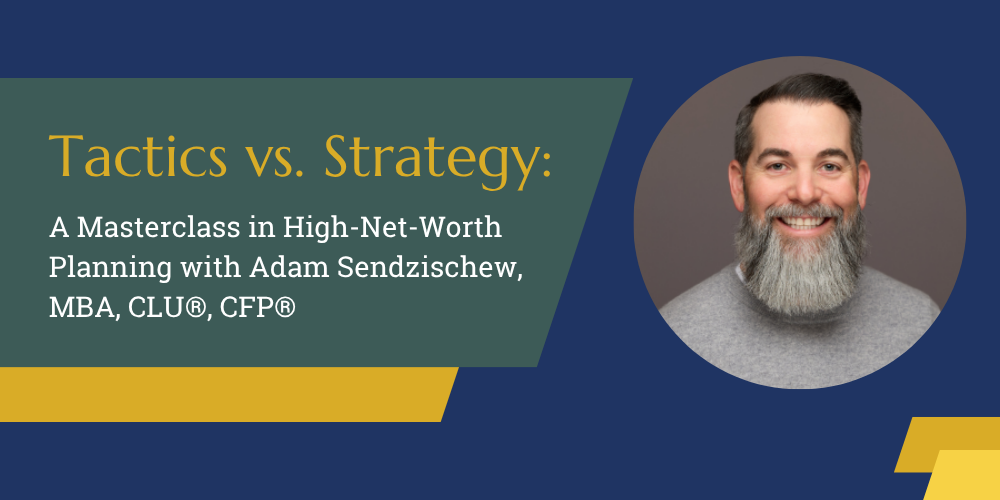
For the sophisticated advisor, Tax Day is the perfect vantage point to look twenty years into the future. In this special April Q&A, we sat down with Adam Sendzischew, CEO & Managing Principal of Phylax Legacy Advisors, to discuss why the current $15M exemption has created a ‘false sense of security’ for many affluent families. From the ‘tax drag’ inherent in modern alternative investments to the ‘tax ambush’ created by the SECURE Act, Adam explains why life insurance is no longer a commodity to be bought, but a strategic asset to be engineered. Join us as we move beyond simple deductions and into the realm of generational tax architecture.
 Background
Three Points: You spend your days thinking about taxes, legacy planning, and protecting family wealth. What originally drew you into this space?
Adam: I didn’t start in this space chasing sales. I was drawn to the idea that my role was to identify, explain, isolate, and solve client problems.
When you sit across from families who have spent decades building something meaningful, you realize very quickly that wealth is a responsibility, not a scoreboard. Taxes, legacy, and protection aren’t separate conversations. They’re the same one, and they have real consequences for real people.
I believe that done correctly, this work can materially change the trajectory of a family for generations. It’s what shapes how I approach every case.
The New Permanent BaselineThree Points: With federal estate tax exemptions now set at $15M (indexed), many clients feel they are “out of the woods.” How are you re‑educating affluent families on why a wait‑and‑see approach to life insurance can still create significant tax risk?
Adam: Permanent compared to what?
The $15M exemption has created a false sense of security. What I try to reframe for clients is simple: this isn’t about today’s exemption. It’s about future exposure.
Tax policy is fluid. Asset values grow. And waiting often means ensuring a larger problem later at a higher cost. But there’s a dimension most people overlook entirely: what happens when you wait too long, and your health runs out? You may not be insurable at all. The cost shifts from pennies on the dollar to dollars on the penny, and that’s not a recoverable position.
The conversation I have with clients stops being “Do I have a taxable estate today?” and starts being “What does my balance sheet look like 10-20 years from now, and what does that mean for my family?” That’s where life insurance stops being a tax tool and becomes a strategic hedge. One you can only buy while you’re still eligible for it.
Step‑Up vs. GiftThree Points: With the current high exemption, the step‑up in basis at death is more valuable than ever. How are you leveraging ILITs and SLATs to help ensure clients don’t accidentally forfeit a step‑up while trying to clear assets from their estate?
Adam: Step-up sounds great, and it is. But it comes at the cost of inclusion in your gross estate. The folks in the big marble buildings writing tax policy ain’t dumb. Under IRC 1014(a), the rule is a basis adjustment, not a guaranteed step-up. If the asset’s value has dropped, you’re stepping down. And for those with a taxable estate, you’re not trading a capital gains problem for nothing. You’re trading it for a 40% estate tax. That is no bueno.
This is one of the more nuanced planning areas right now. The step-up in basis is genuinely valuable, but so is keeping future appreciation out of the estate entirely.
We’re intentional about what we move and what we retain. ILITs and SLATs let us thread that needle, repositioning assets likely to experience significant growth while preserving basis step-up where that benefit has the most impact.
It’s not about choosing one strategy over the other. It’s about coordinating both so the client doesn’t unknowingly trade one tax advantage for another. That coordination is the job.
PPLI for the Modern PortfolioThree Points: For ultra‑high‑net‑worth clients holding significant alternative investments, how is PPLI being used today to wrap tax‑inefficient assets like hedge funds or private credit into a more tax‑favored structure?
Adam: PPLI isn’t new, but the way it’s being used today is a different conversation from even five years ago. The shift happened as alternative investments moved from institutional portfolios into family offices and ultra-high-net-worth balance sheets at scale. That’s when the tax problem got serious enough to demand a structural solution.
Ultra-high-net-worth clients are increasingly holding alternatives such as hedge funds, private credit, and real assets. These are inherently tax-inefficient strategies. High turnover, ordinary income treatment, and K-1 complexity. When you wrap those inside a properly structured PPLI chassis, you’re not changing the investment thesis. You’re changing the tax outcome on every dollar of return it generates.
The math is straightforward. Tax-deferred compounding on assets that would otherwise bleed 2-3% annually to the IRS is a structural advantage, not a marginal one. And for clients with $20M+ in alternatives, that’s not a rounding error. That’s a dynasty.
This conversation belongs early in the portfolio construction discussion, not as an afterthought once the investments are already in place. The client keeps their manager relationships, their allocation strategy, and their risk profile.
The Cost of InactionThree Points: Can you quantify the long‑term tax drag on a typical $20M+ taxable portfolio compared to one structured within a PPLI chassis over a 20‑year horizon?
Adam: Let’s put numbers to it.
A $20M+ taxable portfolio generating 6-8% annually with meaningful exposure to ordinary income or short-term gains is carrying a real tax drag of 2-3% per year, depending on the mix. That doesn’t sound catastrophic until you run it out for 20 years.
Over that horizon, the compounding drag can reduce the portfolio’s terminal value by 30-40% compared to the same assets held inside a PPLI structure. On a $20M portfolio, that’s not a planning footnote. That’s a generational wealth transfer that never happened.
This analysis should sit on the table at every annual review for clients in this category. Not just at the moment of a liquidity event or a tax bill. Every year that passes without addressing it is a year that the tax drag compounds. The family didn’t lose that capital to bad investments. They lost it to inaction. That’s the conversation I want advisors having on April 14th, not April 15th.
Mid‑Conversation PerspectiveThree Points: In your work with family offices and ultra‑wealthy families, what is the most common misconception you still hear about life insurance?
Adam: The misconception I still hear, even from sophisticated clients, is that life insurance is something you buy rather than build.
It usually surfaces in the first meeting, sometimes in the first five minutes, when someone walks in anchored to a number they heard from a friend or a prior advisor. Face amount, premium, term versus permanent. That’s the wrong starting point entirely.
At this level, nobody should be “buying insurance.” They should be engineering a solution. The policy is the wrapper. What’s inside it, the structure, the funding strategy, the ownership, the beneficiary design, that’s where the work is.
My job is to reframe it fast: we’re not talking about what happens when you die. We’re talking about what happens while you’re living, and what your balance sheet looks like for the people who come after you. Once that reframe lands, the conversation changes completely.
This is a not a commodity. This is life insurance.
The Retained Earnings TrapThree Points: Many business owners are sitting on significant retained earnings inside their companies. How does corporate‑owned life insurance help reposition that capital while also preparing for buy‑sell or succession needs?
Adam: Business owners are among the most capital-rich, yet planning-poor, clients in the market.
The right time to have this conversation is before a liquidity event, not after. Once the business sells and the capital is distributed, the options narrow significantly. Inside the entity, the leverage is real. After the fact, you’re working with what’s left.
They’ve built significant retained earnings inside the entity, capital that’s already been taxed once at the corporate level and is sitting there waiting to be taxed again on the way out. The question isn’t whether there’s a problem. The question is whether they’ve been shown a way through it.
Corporate-owned life insurance lets us redeploy that capital into a tax-advantaged environment without triggering a distribution event. The real leverage is what it does simultaneously: it funds the buy-sell, addresses key person exposure, and creates a liquidity mechanism for succession. All from the capital that was otherwise just accumulating a tax liability.
It’s not idle money anymore. It’s working on three problems at once.
The 10‑Year IRA RuleThree Points: With the SECURE Act’s 10‑year distribution rule, heirs can face massive tax bills from inherited IRAs. How are you using life insurance to create liquidity and tax efficiency for the next generation?
Adam: The SECURE Act didn’t just change the rules. It created a tax ambush for many families who didn’t know it was coming.
Heirs are now forced to fully distribute inherited IRAs within 10 years. For children who are in their peak earning years, that means layering a significant taxable distribution on top of an already elevated income tax rate. The IRS timed that perfectly. Again, it “ain’t” an accident.
The time to address this is while the original account holder is still living and has flexibility over their own income. That’s when the planning options are widest. The IRA gets drawn down in a controlled, strategic way, ideally in lower-income years or in tranches that manage bracket exposure. The after-tax proceeds fund a life insurance policy owned outside the estate that transfers income-tax-free to the next generation.
You’re not eliminating the tax. You’re deciding when it gets paid, by whom, and at what rate. That’s the difference between planning and hoping.
The One Big IdeaThree Points: If an advisor makes only one change to their Tax Day client conversations this year, what should it be?
Adam: Stop solving for this year’s tax bill and start mapping the family’s lifetime tax exposure.
April 15th is a deadline. It is not a planning horizon. The advisors having the highest-impact conversations right now aren’t talking about deductions. They’re asking clients what their balance sheet looks like in 2035, 2040, and what that means for the people they’re trying to protect.
That conversation happens best in a dedicated planning meeting, separate from the annual tax return review, where the agenda isn’t what happened last year but what needs to happen over the next decade. That one shift, from annual tax minimization to generational tax strategy, changes everything that follows. The products, the structures, the conversations, the relationships. It’s a different practice, and it produces materially different outcomes for families.
That’s the strategy. Everything else is tactics.
Closing BackgroundThree Points: When you are not advising families and designing strategies, what do you enjoy doing outside the office?
Adam: Outside the office, I’m probably out with my two dogs or involved in something in my community. Personally or professionally, the lines blur a little, and I’m okay with that.
I’m active in MDRT, Top of the Table, and FINSECA, not because I need more to do, but because I believe this industry gets better when the people in it invest in it. I came up learning from advisors who generously gave their time, and I try to return the favor.
At the end of the day, I’m an entrepreneur who happens to work in financial services. I didn’t choose this path because it was safe or simple. I chose it because the work is hard, the stakes are real, and when you get it right, the impact lasts longer than you do. That still means something to me.
 About Adam Sendzischew, MBA, CLU®, CFP®
Adam Sendzischew specializes in solving the unique puzzles faced by the world’s most successful families. With a focus on ultra-high-net-worth wealth transfer, Adam integrates complex life insurance concepts and private placement into holistic estate plans. His work is about more than mitigating risk; it is about enhancing the architecture of wealth to help ensure it remains a force for good for the family and the community.
A graduate of the University of Miami (Top 2%) with an MBA in Finance, Adam holds a rare combination of designations that allow him to collaborate seamlessly with a client’s legal and tax advisors, including:
Adam’s approach is defined by a global perspective and an unwavering commitment to values-driven planning. Adam bridges the gap between sophisticated financial engineering and the human element of legacy.
Additional Information & Disclosures:
CA Insurance License #0G10478 | Registered Branch Address & Phone Number: 470 Columbia Drive, Suite 100E, West Palm Beach, FL 33409 | 561.712.9799
Certified Financial Planner Board of Standards Center for Financial Planning, Inc. owns and licenses the certification marks CFP®, CERTIFIED FINANCIAL PLANNER®, and CFP® (with plaque design) in the United States to Certified Financial Planner Board of Standards, Inc., which authorizes individuals who successfully complete the organization’s initial and ongoing certification requirements to use the certification marks.
Raymond James and its advisors do not offer tax or legal advice. You should discuss any tax or legal matters with the appropriate professional.
Securities offered through Raymond James Financial Services, Inc., member FINRA/SIPC, marketed as Phylax Legacy Advisors. Investment advisory services offered through Raymond James Financial Services Advisors, Inc. Phylax Legacy Advisors, a Greenberg & Rapp company, is separately owned and operated and not independently registered as a broker-dealer or investment adviser.